
Work
Packages
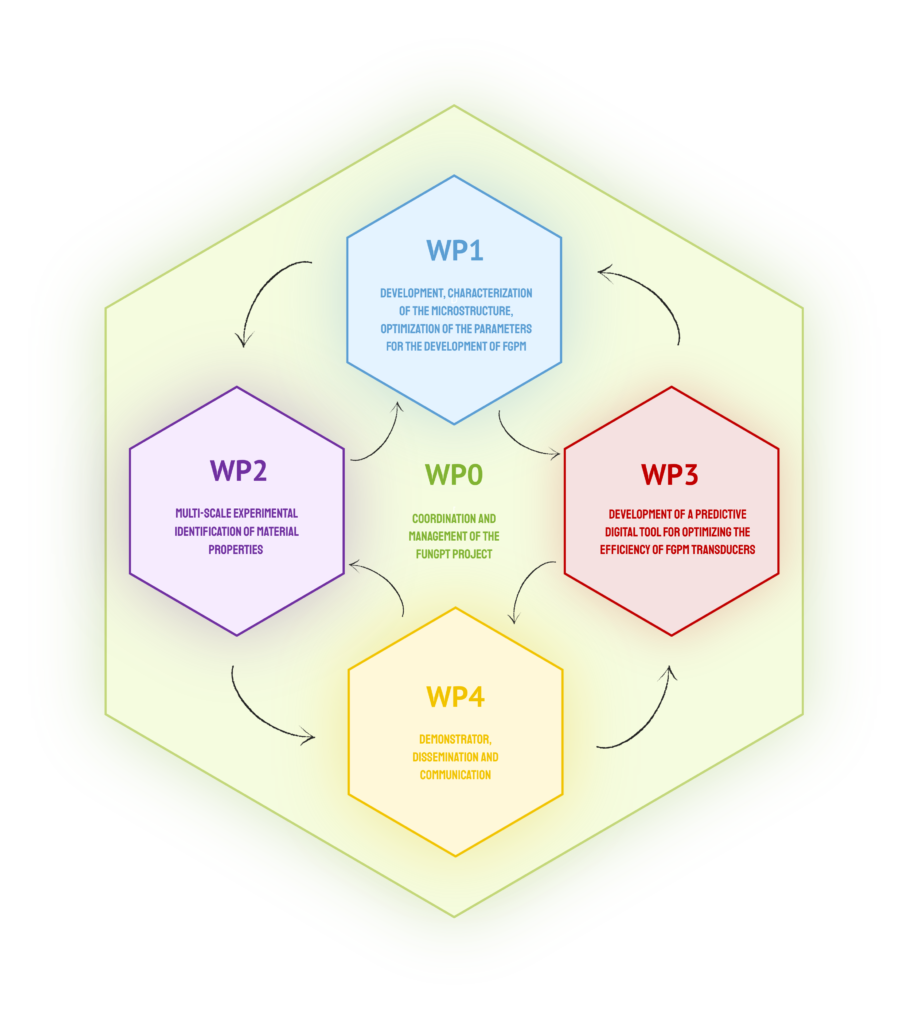
WPO
Project management
Lead: I. Bruant (LEME)
It will be led by I. Bruant (LEME). It involves managing the project to ensure that the expected scientific results are achieved within the defined timeframe and with the allocated resources, and to meet the requirements of the ASTRID programme.
WP1
Processing, Microstructural Characterization, Process Development, and Optimization
Lead: D. Bregiroux (LCMCP)
Involved teams : LCMCP (D. Bregiroux, A. Perez, A. Courpied ), FEMTO-ST (S. Margueron)
The aim of WP1 is to develop FGPM materials in a controlled and reproducible manner by mastering the entire processing chain: powder mixing, sintering, electrode position, and polarization. The materials developed within WP1 will undergo electrical and mechanical characterization in WP2, which will in turn provide data for the models studied in WP3. In a feedback loop, the results generated by WP2 and WP3 will allow for the optimization of WP1’s processing parameters.
The originality is the development of a low-cost (low-energy) FGPM production process called cold sintering, which uses a much lower temperature range than SPS (Spark Plasma Sintering), i.e. 300-400°C vs. 900-1000°C. This would enable the production of FGPMs composed of materials previously considered impossible to co-sinter (such as ceramic + low-melting-point metal), while avoiding the reduction of transition elements within the ceramic phase. SPS trials will serve as benchmarks to qualify the Cold Sintering process for FGPM fabrication.
WP2
Multi-scale Experimental Identification of FGPM Properties
Lead: G. Chevallier (CréA)
Involved team : CréA (G. Chevallier) , FEMTO-ST (S. Margueron, F. Boutenel), LEME (J. Zghal, J. Cedelle, J. Petit)
This WP covers all mechanical, thermal, and electrical characterization tests of the FGPM under static, quasi-static, and dynamic loading, as well as the study of the FGPM’s fatigue behavior. These results provide the input parameters for subsequent numerical simulations regarding FGPM functionality (WP3), process optimization (WP1), and demonstrator design (WP4).
These characterization tests will be hold in FEMTO-ST, LEME and CréA wich have complementary skills and equipments.
WP3
Development of a predictive numerical tool for FGPM efficiency optimization
Lead: I. Bruant (LEME)
Involved team : LEME (I. Bruant, J. Zghal, A. Barki), LTDS (B. Chomette, M. Collet), CréA (G. Chevallier)
In this WP, a finite element numerical tool will be developed to simulate and optimize the active vibration control of FGPM structures, accounting for thermo-piezoelectric coupling and the functionally graded material structure through a multi-scale approach. Furthermore, a crack propagation model will be developed based on phase-field formulations that incorporate these couplings. In all simulations, the physical properties obtained in WP2 will be utilized. The results will guide the optimization of processing parameters in WP1.
WP4
Demonstrator, dissemination and communication
Lead : M. Collet (LTDS)
Involved team : LTDS (M. Collet, B. Chomette, K. Billon), LEME, LCMCP, FEMTO-ST, CréA
The aim of this WP is the dissemination and communication about the main experimental and numerical results of the project. Drawing on the expertise of the LTDS, and based on the results of WP1, WP2 and WP3, an integrated FGPM demonstrator, approximately 40 mm length and 3 mm thick, will be designed to allow control of vibration isolation. Its performance in terms of fatigue and resistance to temperature gradients will be demonstrated by comparing it with conventional PZT transducers.